Lower Silesian Digital Library contains 110 252 digital objects
Object
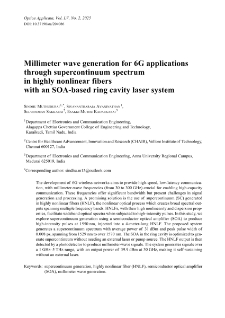
Title: Millimeter wave generation for 6G applications through supercontinuum spectrum in highly nonlinear fibers with an SOA-based ring cavity laser system
Creator:
Muthudurai, Sindhu ; Avaninathan, Sivanantharaja ; Sakkarai, Selvendran ; Kadarkarai, Esakki Muthu
Contributor:
Popiołek-Masajada, Agnieszka. Redakcja
Description:
Optica Applicata, Vol. 55, 2025, nr 2, s. 241-255 ; Optica Applicata is an international journal, published in a non-periodical form in the years 1971-1973 and quarterly since 1973. From the beginning of the year 2008, Optica Applicata is an Open Access journal available online via the Internet, with free access to the full text of articles serving the best interests of the scientific community. The journal is abstracted and indexed in: Chemical Abstracts, Compendex, Current Contents, Inspec, Referativnyj Zhurnal, SCI Expanded, Scopus, Ulrich’s Periodicals Directory ; click here to follow the link
Abstrakt:
Publisher:
Oficyna Wydawnicza Politechniki Wrocławskiej
Place of publication:
Date:
Resource Type:
Resource Identifier:
doi:10.37190/oa/204086 ; oai:dbc.wroc.pl:141590
Source:
<sygn. PWr A3481II> ; click here to follow the link ; click here to follow the link
Language:
Relation:
Optica Applicata ; Optica Applicata, Vol. 55, 2025 ; Optica Applicata, Vol. 55, 2025, nr 2 ; Politechnika Wrocławska. Wydział Podstawowych Problemów Techniki
Rights:
Wszystkie prawa zastrzeżone (Copyright)
Access Rights:
Dla wszystkich w zakresie dozwolonego użytku
Location:
Group publication title:
Object collections:
- Lower Silesian Digital Library > Participants of the Consortium > 01. Wrocław University of Science and Technology > Journals WUoT > Journals published at Wrocław University of Technology > Optica Applicata
- Lower Silesian Digital Library > Resources > 2. Czasopisma > Czasopisma współczesne
- Lower Silesian Digital Library > Fields of science > 6. Nauki ścisłe i przyrodnicze
Last modified:
Nov 6, 2025
In our library since:
Nov 6, 2025
Number of object content hits:
44
All available object's versions:
https://dbc.wroc.pl/publication/180428
Show description in RDF format:
Show description in OAI-PMH format:
Objects Similar
Lindinger, Albrecht Plewicki, Mateusz Weber, Stefan M. Lupulescu, Cosmin Wöste, Ludger Wilk, Ireneusz. Redakcja Gaj, Miron. Redakcja
Wang, Fei Xia, Guangqiong Wu, Zhengmao Gaj, Miron. Redakcja Wilk, Ireneusz. Redakcja
Srivastava, Vikrant K. Priye, Vishnu Gaj, Miron. Redakcja Urbańczyk, Wacław. Redakcja
Ab-Rahman, Mohammad Syuhaimi Urbańczyk, Wacław. Redakcja
Yang, Yunxia Yang, Hua Tong, Xiongfeng Zhao, Saili Chen, Shuyuan Urbańczyk, Wacław. Redakcja
Bookey, Henry T. Buczyński, Ryszard Wischnewski, Andrew Pysz, Dariusz Kasztelanic, Rafał Waddie, Andrew J. Stępień, Ryszard Kar, Ajoy K. Taghizadeh, Mohammad R.
Hu, Zhefeng Sun, Junqiang Gaj, Miron. Redakcja Urbańczyk, Wacław. Redakcja
Kaur, Sanmukh Shukla, Manoj Kumar Urbańczyk, Wacław. Redakcja